
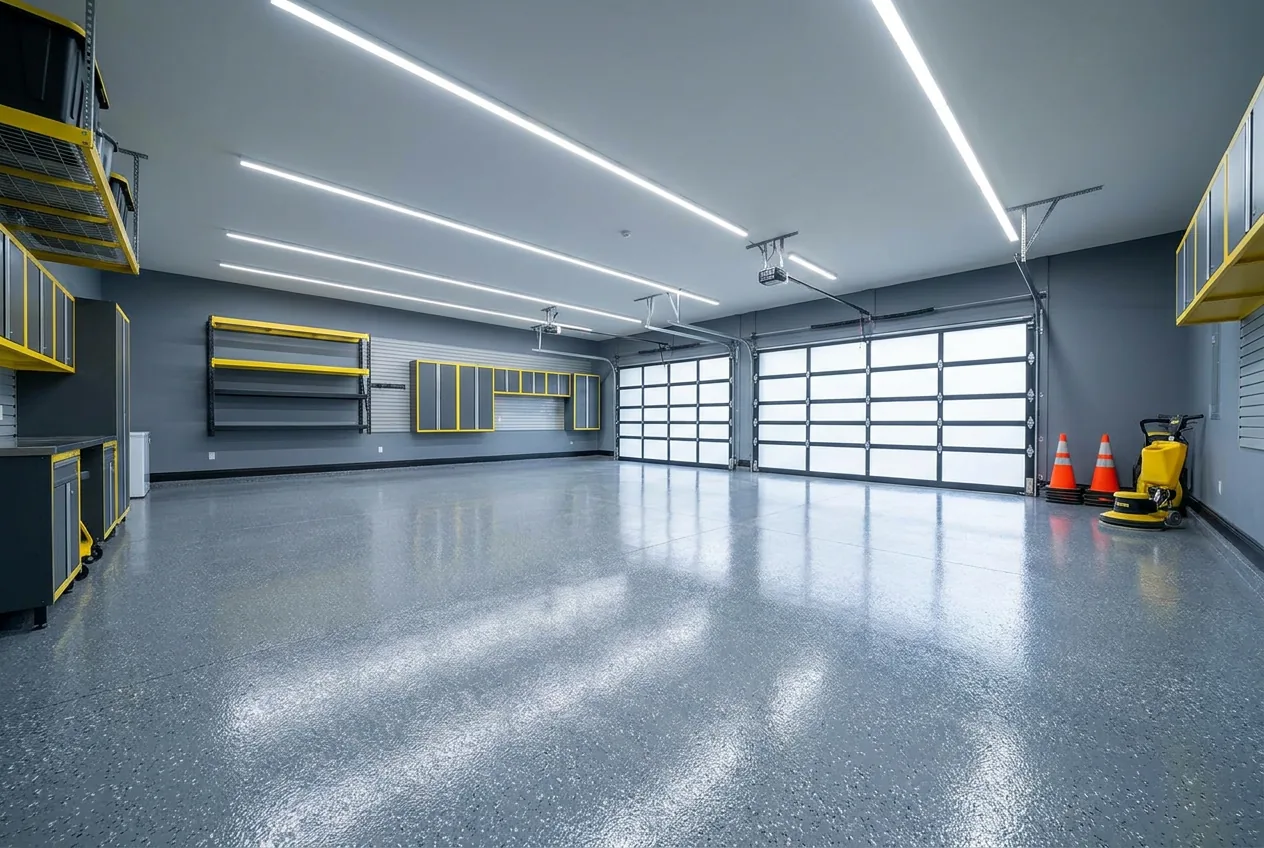
An epoxy floor coating fails in one of two ways. It delaminates, lifting from the concrete in sheets or blisters, or it wears through. Delamination accounts for the overwhelming majority of failures, and it is almost never the fault of the resin. It is the fault of what happened, or did not happen, to the slab before the resin was mixed. Understanding that single fact is enough to tell a competent quote from a cheap one.
Epoxy is a two-part thermoset: a resin and a hardener that react on mixing and cure into a rigid, chemically bonded film. Once that reaction starts it cannot be paused, which is why pot life appears on every technical data sheet and why an installer working in the heat mixes smaller batches. The cured film is hard, abrasion resistant, and resistant to most oils, fuels and many chemicals, which is what makes it the default for garages, workshops, basements, laundry rooms and busy family kitchens across the United States.
Surface profile is the whole game
Epoxy bonds mechanically. It needs texture to grip, and the industry measures that texture on the International Concrete Repair Institute’s Concrete Surface Profile scale, which runs from CSP 1, roughly the feel of 60-grit sandpaper, to CSP 9, a heavy scarified surface. Standard coatings want CSP 3 to 4, achievable by medium shot blasting or a coarse diamond grind. High-build systems and epoxy mortars want CSP 5 to 6, which in practice means aggressive shot blasting.
Shot blasting propels steel media at the slab and produces profiles in the CSP 3 to 7 range depending on media size and machine speed. It is the preferred method for larger residential slabs because it is fast, dry, and leaves a consistent profile. Diamond grinding is used where dust control, edges, or smaller areas dominate. What matters is that a profile is created at all, and this is exactly where cheap quotes economize.
Acid etching is the shortcut. It is sold as surface preparation, it is cheap, and it does not produce a reliable profile. It attacks the paste unevenly, leaves residue that must be fully neutralized and rinsed, and cannot touch a slab that has been power troweled hard. Coatings applied over an acid-etched floor are the single most common source of the peeling garage floors that give epoxy its mixed reputation among homeowners. A quote that specifies acid etching for anything beyond a trivial repair is quoting a different, shorter-lived product.
Moisture, and the test that should precede every quote
Concrete on grade transmits water vapor upward continuously. An epoxy film is relatively impermeable, so that vapor accumulates at the bond line and eventually pushes the coating off in blisters. This has nothing to do with visible dampness; a slab can look bone dry and still be driving several pounds of moisture per day.
Two standardized tests quantify it. ASTM F1869, the anhydrous calcium chloride test, measures moisture vapor emission rate in pounds per thousand square feet per twenty-four hours, and most manufacturers require consultation above five pounds. ASTM F2170 measures relative humidity in situ using probes set into drilled holes, and is now generally considered the more reliable of the two because it reads the slab’s internal condition rather than surface emission alone.
Where readings exceed the coating’s tolerance, the answer is a moisture vapor barrier primer, an epoxy formulated specifically to hold back vapor pressure, applied before the build coats. It adds cost. Skipping the test to avoid discovering the need for it is why floors fail in year two. On a slab with no vapor retarder beneath it, which describes a great many older residential garages and basements, testing is not optional.
Solids content, film thickness and what you are actually buying
The most useful number on a product data sheet is solids content. A 100% solids epoxy contains no water or solvent carrier, so nothing evaporates during cure: the dry film thickness equals the wet film thickness, there is no shrinkage, and there is no VOC off-gassing. A water-based or solvent-borne epoxy at 50% solids applied at the same wet thickness leaves half the film behind.
This is why comparing quotes on the number of coats is meaningless and comparing them on mils of dry film thickness is meaningful. A single 100% solids high-build coat at sixteen to eighteen mils delivers more wear layer than three thin water-based coats. For a residential garage, ten mils of basecoat is a reasonable minimum. Thicker heavy-duty builds commonly specify twenty to forty mils, and heavy-duty systems build to sixty mils or beyond.
Water-based thin-film epoxies are not inferior products, they are different ones. They are more forgiving of moisture, easier to apply, lower odor, and appropriate where a light-duty decorative finish is the goal. Sold as a heavy-duty floor, they disappoint. The failure is in the specification, not the can.
Systems, topcoats and the details that decide longevity
Most floors are systems rather than a single product. A primer wets the profile and anchors the build. A body coat provides thickness. Decorative flake or quartz is broadcast into the wet body coat where texture and appearance are wanted, and the excess is swept off once cured. A clear topcoat locks the aggregate down and carries the wear.
The topcoat is where epoxy is often the wrong choice. Epoxy ambers and chalks under ultraviolet light, so any floor seeing daylight, an open garage door included, benefits from a polyaspartic or aliphatic urethane topcoat that holds its color. Urethanes are also more flexible and more scratch resistant. The common professional build is therefore an epoxy body with a urethane or polyaspartic finish, and a quote offering an epoxy topcoat on a sunlit floor is worth questioning.
Ambient conditions during installation matter as much as the products. Epoxy cures by chemical reaction, and that reaction slows sharply as temperature falls, with most formulations wanting slab temperatures above fifty degrees Fahrenheit and rising rather than falling. Slab temperature must also stay at least five degrees above the dew point, or condensation forms on the surface and destroys the bond. A crew that checks slab temperature and dew point before mixing is a crew that has been burned before and learned from it.
Costs across the United States are driven by area, the condition of the existing slab, whether an old coating has to come off, the profile method required, the moisture mitigation needed, total film thickness and the choice of topcoat. Comparing bids is only possible when all of them state the preparation method, the mils of dry film, and the moisture test results. Two quotes for the same garage can differ threefold, and almost always the difference is in those three lines rather than in the resin.
States in the Northeast
States in the Midwest
- Epoxy Floor Coating in Illinois
- Epoxy Floor Coating in Indiana
- Epoxy Floor Coating in Iowa
- Epoxy Floor Coating in Kansas
- Epoxy Floor Coating in Michigan
- Epoxy Floor Coating in Minnesota
- Epoxy Floor Coating in Missouri
- Epoxy Floor Coating in Nebraska
- Epoxy Floor Coating in North Dakota
- Epoxy Floor Coating in Ohio
- Epoxy Floor Coating in South Dakota
- Epoxy Floor Coating in Wisconsin
States in the South
- Epoxy Floor Coating in Alabama
- Epoxy Floor Coating in Arkansas
- Epoxy Floor Coating in Delaware
- Epoxy Floor Coating in Florida
- Epoxy Floor Coating in Georgia
- Epoxy Floor Coating in Kentucky
- Epoxy Floor Coating in Louisiana
- Epoxy Floor Coating in Maryland
- Epoxy Floor Coating in Mississippi
- Epoxy Floor Coating in North Carolina
- Epoxy Floor Coating in Oklahoma
- Epoxy Floor Coating in South Carolina
- Epoxy Floor Coating in Tennessee
- Epoxy Floor Coating in Texas
- Epoxy Floor Coating in Virginia
- Epoxy Floor Coating in Washington, D.C.
- Epoxy Floor Coating in West Virginia
States in the West
- Epoxy Floor Coating in Alaska
- Epoxy Floor Coating in Arizona
- Epoxy Floor Coating in California
- Epoxy Floor Coating in Colorado
- Epoxy Floor Coating in Hawaii
- Epoxy Floor Coating in Idaho
- Epoxy Floor Coating in Montana
- Epoxy Floor Coating in Nevada
- Epoxy Floor Coating in New Mexico
- Epoxy Floor Coating in Oregon
- Epoxy Floor Coating in Utah
- Epoxy Floor Coating in Washington
- Epoxy Floor Coating in Wyoming
Major cities across the United States
- Epoxy Floor Coating in New York City, NY
- Epoxy Floor Coating in Long Island, NY
- Epoxy Floor Coating in Los Angeles, CA
- Epoxy Floor Coating in Chicago, IL
- Epoxy Floor Coating in Chicago, WI
- Epoxy Floor Coating in Brooklyn, NY
- Epoxy Floor Coating in Queens, NY
- Epoxy Floor Coating in Houston, TX
- Epoxy Floor Coating in Manhattan, NY
- Epoxy Floor Coating in Phoenix, AZ
- Epoxy Floor Coating in Philadelphia, PA
- Epoxy Floor Coating in Eden, CA
- Epoxy Floor Coating in San Antonio, TX
- Epoxy Floor Coating in The Bronx, NY
- Epoxy Floor Coating in Deer Valley, AZ
- Epoxy Floor Coating in San Diego, CA
- Epoxy Floor Coating in Dallas, TX
- Epoxy Floor Coating in Garfield, UT
- Epoxy Floor Coating in San Jose, CA
- Epoxy Floor Coating in O‘ahu, HI
- Epoxy Floor Coating in Austin, TX
- Epoxy Floor Coating in Jacksonville, FL
- Epoxy Floor Coating in San Francisco, CA
- Epoxy Floor Coating in Columbus, OH
- Epoxy Floor Coating in Indianapolis, IN
- Epoxy Floor Coating in Fort Worth, TX
- Epoxy Floor Coating in Charlotte, NC
- Epoxy Floor Coating in North Charlotte, NC
- Epoxy Floor Coating in Louisville, KY
- Epoxy Floor Coating in Lakeside, GA
- Epoxy Floor Coating in Seattle, WA
- Epoxy Floor Coating in Denver, CO
- Epoxy Floor Coating in Washington City, DC
- Epoxy Floor Coating in El Paso, TX
- Epoxy Floor Coating in Boston, MA
- Epoxy Floor Coating in Nashville, TN
- Epoxy Floor Coating in Detroit, MI
- Epoxy Floor Coating in Una, TN
- Epoxy Floor Coating in Memphis, TN
- Epoxy Floor Coating in New South Memphis, TN
- Epoxy Floor Coating in Portland, OR
- Epoxy Floor Coating in Oklahoma City, OK
- Epoxy Floor Coating in Las Vegas, NV
- Epoxy Floor Coating in Baltimore, MD
- Epoxy Floor Coating in Washington, D.C., DC
- Epoxy Floor Coating in Milwaukee, WI
- Epoxy Floor Coating in South Boston, MA
- Epoxy Floor Coating in Fernwood, PA
- Epoxy Floor Coating in Albuquerque, NM
- Epoxy Floor Coating in Williamson, TX
Epoxy floor coating in the United States, USA
usually call after looking at a bare concrete slab that is dusting, staining, or simply old. Epoxy floor coating is a multi-coat resin system applied directly over a prepared slab. The chemistry bonds at a molecular level with the concrete and cures into a rigid, chemical-resistant surface several times harder than the slab beneath.

Most modern systems are 80 to 100 mil thick once cured. The visual hallmark is a glossy mirror finish, often with decorative flake or metallic. Beyond the look, the slab is now sealed: motor oil, brake fluid, road salt and acid spills wipe off instead of soaking in.
Free epoxy estimate in the United States, USA by phone
Call (888) 217-7038Installation process in the United States, USA

- Phone quote.Square footage, slab condition, finish preference. Most quotes are firm after one call and a couple of photos.
- Surface prep.Diamond grinding or shot blasting opens the pores. Cracks routed and filled. This is where most failed coatings fail, installers do not skip it.
- Coats applied.Primer, basecoat, flake or metallic broadcast, then a UV-stable topcoat. Professional-grade two-part resins.
- Cure and handover.Foot-traffic in 24 hours, vehicles in 72. Before-and-after photos delivered with the keys.
Talk to a US epoxy pro now in the United States, USA
One call. A written quote. No obligation.
Call (888) 217-7038Frequently asked questions

How much does epoxy flooring cost in the United States, USA?
Residential garages typically run $4 to $10 per square foot installed, depending on finish complexity and prep needed. A two-car garage usually lands between $1,800 and $4,500. The phone quote is firm before any deposit is taken.
How long does the coating last?
A properly prepped professional-grade install lasts 15 to 25 years in residential garage use. warranty terms, when offered, are stated in your written quote.
Do you serve United States?
Yes, installers are dispatched . One call confirms availability and gives you a written estimate.
How long until I can park on it?
Foot traffic in 24 hours, full vehicle traffic at 72 hours. Hot-tire pickup is not a concern with professional-grade resins.
Should I check the installer's license and insurance?
Yes. Licensing rules vary by state: ask the installer for their license number and certificate of insurance before work begins.